The baptism dispute and Apollo’s awakening restrained
The ChangelingThe baptism dispute and Apollo’s awakening restrained marks a decisive break in Apollo Kagwa and Emma Valentine’s household: a conversation about baptizing their son Brian Kagwa turns into an argument about surveillance, mental distress, and who can be trusted to protect the child, before the narrative reveals Apollo chained in his own kitchen. The sequence moves from ordinary childcare to a locked door and then to bodily confinement, making the family’s collapse tangible through familiar objects—a bowl, a phone, a chair, and a bicycle lock.
The Baptism Becomes a Dispute
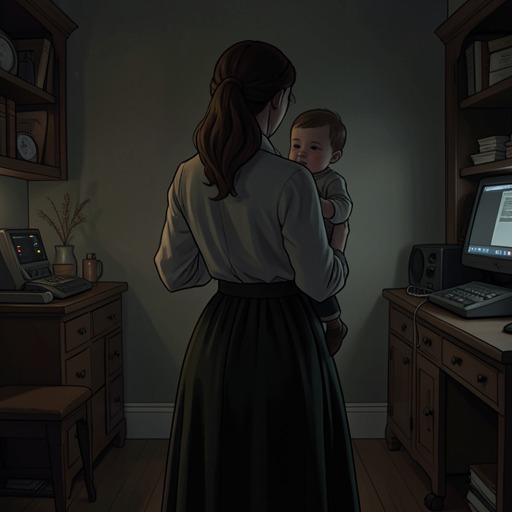
Emma raises the baptism while Apollo is at the table with Brian, who bats at a shoe and eats oatmeal from a spoon. She has arranged an appointment for that day, in an hour, at Holyrood Episcopal Church with Father Hagen. The immediate occasion sounds practical, but Apollo is caught off guard: he initially asks whether she means Brian, then learns that his mother has been asking for the baptism since the child’s birth. The short notice turns an established family request into a decision that Apollo feels he has not been included in.
When Emma says she can take Brian alone, Apollo insists that she will not take his son anywhere without him. His response makes the disagreement about more than church or timing. He clears the bowls and handles the oatmeal pot, moving around the kitchen because he needs to get up from the table; routine domestic activity becomes a physical outlet for agitation. The scene’s ordinary parenting details persist even as the adults’ trust in each other deteriorates: Brian accepts his food, and Apollo is still attending to his needs while the argument gathers force.
Threatening Messages and Broken Communication
Apollo’s question about Emma’s phone in the garbage brings the conflict to its most concrete source. Emma says she received another text the previous night, accompanying a photograph taken through the passenger-side window of a Zipcar. Apollo and Brian were inside; the baby was secured in a car seat, and the car appeared to be stopped at a red light. Emma’s account makes the threat intimate: the unseen photographer came close enough to capture Brian in the back seat. The accompanying message, as Emma reports it, said that the sender had got him.
Apollo’s reply focuses on the way she refers to their son, correcting her in a shout that his name is Brian. He drops the pot into the sink, startling the baby, then rushes to pick him up, apologizes, and holds him tightly. The gesture is protective, but its force is also unsettling: comfort arrives in the same burst of anger that frightened Brian. Apollo demands to see one of the messages on Emma’s phone. She says they are gone, as they always are. The account therefore offers him no visible proof at the moment he demands it, while Emma’s fear remains plainly present.
Emma explains that she wants another person present because she and Apollo are no longer talking to each other. Advice on a message board led her to consider therapy or church, but they cannot afford therapy. Apollo mocks the mothers who offered suggestions and tells Emma that she is the problem, ending with an instruction to take another pill. Instead of treating the baptism as an attempt to bring in support, he reads Emma’s proposal as evidence against her. Their disagreement becomes a closed loop: she seeks an outside presence because conversation between them has failed, and he uses that choice to dismiss her.
The Door and Apollo’s Promise
Emma leaves the kitchen and returns wearing a coat over her shapeless clothes. Apollo notices how small she has become and feels himself wobble, a moment that registers her visible condition without explaining its cause. She tells him that he does not see, but that he will. When she leaves and slams the door, her keys remain hanging on the wall. Apollo instinctively thinks of giving them to her, then stops himself and locks her out.
That choice changes the practical stakes of their dispute. Emma is outside without the keys she left behind, while Apollo remains inside with Brian. He holds his son up and promises that, whatever happens, Brian is coming with him. The promise sounds like a declaration of protection, but the scene has already shown how Apollo’s protective impulses are entangled with anger and control: he rejects Emma’s solo trip, grips Brian tightly after startling him, and now controls access to their home. The sequence does not settle who is safer or what Emma intends; it leaves the family divided at the threshold.
Awakening in the Kitchen
The narration then breaks sharply from the argument into Apollo’s confused experience of waking. He hears someone screaming but cannot at first tell whether the voice is his. He imagines himself underwater, sunk and unable to see, with the screams acting like a light that might guide him toward the surface. The image gives his return to consciousness the structure of a struggle through darkness, while the sound of another person’s agony is the only point of orientation.
Apollo tries to move his arms, but they are numb and chained behind him; he has been restrained for hours. Once he opens his eyes, he recognizes his own New York City apartment and kitchen. He is sitting in one of the white IKEA chairs Emma ordered six months earlier, backed into a corner, sweating and covered in still-moist vomit. His feet and shoulders rattle when he moves. A U-lock loops around his throat and holds him to the steam pipe, which is hot because the apartment’s radiators are running. If Apollo leans forward, the lock chokes him; if he slumps backward, his exposed neck touches the pipe and burns. He has to remain exactly upright to avoid both dangers.
The domestic setting has become an apparatus of restraint. The chair bought for the household, the heating system, and the bicycle lock are no longer background furnishings: together they determine whether Apollo can breathe or keep his skin from the hot pipe. The scene ends with him awake but trapped, his arms bound and his movement constrained by the room itself. It does not identify who chained him or explain how he came to be in the chair, so the abrupt transition transforms the preceding promise to protect Brian into an unresolved reversal rather than a completed act of rescue.
Narrative Significance
The event’s force lies in the contrast between the ordinary and the perilous. A scheduled baptism, a baby’s meal, and a phone discarded in the garbage give way to a threatening photograph, a locked-out spouse, and a man chained by the throat. Apollo and Emma both frame their actions around Brian’s safety, yet their means of protecting him have become incompatible: Emma seeks help outside the couple, while Apollo rejects her account and asserts control over where she may take their son.
The shift into Apollo’s underwater imagery also withholds the transition between the family argument and his restraint. The reader experiences the consequences before learning their cause, sharing Apollo’s limited perception as he follows the scream back to consciousness. Because the narrative leaves the restraining agent and the circumstances unexplained here, the event closes on a double uncertainty: Apollo is physically trapped, and the conflict over whom to believe remains unresolved.